Barley malt (pilsner malt) and smoked malt intended for use in beer brewing or elsewhere in the food industry
The phenol fraction collected through steam distillation is mixed with 4-amino- 2,3-dimethyl-1-phenyl-3-pyrazolin-5-one (4-aminophenazone) under alkaline conditions and oxidized by potassium hexacyanoferrate(III) to form a pigment (fig. 1), which after extraction with chloroform, can be measured spectrophotometrically.
Malt intended for use in beer brewing or elsewhere in the food industry
A (modified) Congress wort is produced from malt samples prior to analysis. NDMA present in the Congress wort is extracted using dichloromethane followed by concentration of the eluate. The determination is performed with a gas chromatograph using a packed Carbowax 20M column with a specific TEA detector (thermal energy analyzer); nitrosodipropylamine (NDPA) serves as an internal standard.
This detector analyzes nitrosamine according to the following procedure:
After exiting the GC column, the separated substances are heated to 500 °C in a pyrolyzer. At this temperature, the N-NO bond of the nitrosamine is broken, thus forming an NO radical (NO۰):
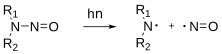
The gas mixture then flows through a special filter (CTRTM gas stream filter), which only allows the carrier gas and the NO radicals to pass. After exiting the filter, the NO radicals flow into a reaction chamber along with ozone, which is created by a special generator. The following chemical reactions take place in the chamber:
|
NO• + O3 |
→ |
NO2• |
|
NO2• |
→ |
NO2 + h•ν |
These NO radicals react with ozone, forming nitrogen dioxide in an excited state (NO2•). The NO2• molecules decompose spontaneously to form nitrogen dioxide in its common form (NO2), emitting radiation (h•ν) with a wavelength of approx. 600 nm.
This method describes how to determine the moisture content of specialty malt.
Specialty malt intended for use in beer brewing or elsewhere in the food industry
Determination of xanthohumol and isoxanthohumol
All beers, beer-based beverages, wort, ethanol extracts, CO2 spent hops and xanthohumol products
Xanthohumol and isoxanthohumol are dissolved with acetonitrile from the sample and following separation, are determined using a Nucleodur C18 column and UV detection.
The cations in beer and wort are determined with this analysis.
This method is suitable for both wort and beer.
Inductively coupled plasma optical emission spectroscopy (ICP-OES) is a fast and reliable method for the laboratory analysis of metals. Inductively coupled plasma (ICP), a high frequency field of ionized gas, serves as a medium for atomizing and exciting the substances found in samples. Liquid, dissolved or aerosol samples are injected into the ionized gas stream. In emission spectroscopy, ICP can be used in conjunction with a number of optical and electronic systems either simultaneously or sequentially in multi-element spectrometers. In the plasma, the atoms and ions are excited to a higher energy state bringing about the emission of electromagnetic radiation (light), primarily in the ultraviolet and visible region of the spectrum. Metals ordinarily occur as ions in the temperature range typical for ICP of 6000 to 10000 K; however, non-metals and metalloids are only partially ionized.
ICP-OES operates within a very wide range. This usually encompasses six orders of magnitude in concentrations smaller than μg/l up to g/l, depending upon the element and the concentrations used for the set of analysis data. With ICP-OES, beer and wort can also be analyzed without prior processing of the samples, in contrast to AAS. Methods for determining the following in beer and wort will be described below: Al, B, Ba, Ca, Co, Cu, Fe, K, Mg, Mn, Mo, Na, P, Si, Sr, Sn and Zn.
This method is suitable for the determination of steam-volatile aroma compounds in wort.
Volatile aroma compounds are driven out of the sample through steam distillation. The ethanol distillate is adjusted to be alkaline and saturated with NaCl. The extraction of the aroma compounds is performed by shaking out with dichloromethane and the phases separated by centrifuging. The organic phase is further concentrated in a stream of nitrogen gas. An ammonia solution is added to remove the acids, because the acids would co-elute, thus preventing quantification of the target substances.